- Available in 48 states (excluding Alabama and Mississippi)
- No hidden membership, consultation, or shipping costs
- Care reviewed by a licensed provider in your state
- Prescription issued only when clinically appropriate


*Actual vial appearance, contents, and dosage may vary and is based on your prescription.
AOD-9604 / MOTS-c / Tesamorelin
The AOD-9604 / MOTS-c / Tesamorelin stack combines three peptides that have been studied in scientific literature for metabolic regulation pathways, energy signaling, and growth-hormone–related physiologic signaling (via pituitary regulation). Tesamorelin is a GHRH analog studied in human trials for visceral fat reduction in specific populations, MOTS-c is a mitochondrial-derived peptide studied largely in preclinical and mechanistic research for metabolic homeostasis, and AOD-9604 is a growth-hormone fragment studied in early clinical and preclinical settings for fat-metabolism pathways.
Free Shipping
Medical Consultation Included


(educational, not guaranteed outcomes)
Supports Visceral Fat / Abdominal Adiposity Pathways
Tesamorelin has been evaluated in randomized trials for reductions in visceral adipose tissue (VAT) in HIV-associated abdominal adiposity populations.
Supports Metabolic Signaling & Energy Regulation
MOTS-c has been described as a mitochondrial-encoded peptide involved in metabolic homeostasis and cellular energy regulation pathways in published research.
Supports Lipid Metabolism & Fat Utilization Mechanisms
AOD-9604 (a fragment derived from the lipolytic domain of HGH) has been studied in animal models and discussed in obesity pharmacotherapy literature, including randomized human trial references.
Supports Physical Resilience & Recovery Processes
Growth hormone signaling pathways (supported indirectly via GHRH analog action) and mitochondrial signaling peptides have been investigated for roles in recovery-related physiology and muscle/metabolic resilience in preclinical and clinical contexts.
Supports Whole-Body Wellness & Longevity-Focused Pathways
This stack is often positioned around wellness goals tied to metabolic balance and age-related physiologic signaling. Research depth differs across compounds (Tesamorelin has stronger human trial data; MOTS-c and AOD-9604 are more preclinical/early-human).
- Initial 3-month care period
- Designed to support continuity, monitoring, and consistency of care
- Ongoing care options available following the initial period, with the ability to manage or discontinue thereafter
- Clinical review typically completed within 24 hours
- Pharmacy processing may take 2–7 business days, depending on availability
- Once dispensed, medication is shipped via 2-day delivery
Prescriptions are issued by licensed healthcare providers based on an individual clinical evaluation and medical eligibility. Compounded medications are not FDA-approved, and their safety and effectiveness have not been independently evaluated by the FDA.
This information is provided for educational purposes only and is not intended to diagnose, treat, cure, or prevent any disease.
Important Note:
Information provided is for educational purposes only and does not constitute medical advice. All care and prescriptions are provided solely at the discretion of a licensed healthcare provider following an individual evaluation.
Tesamorelin
Falutz et al. — Tesamorelin reduces visceral fat (randomized trials)
Falutz et al. — Effects of tesamorelin on visceral fat (trial report)
Stanley et al. — VAT reduction associated outcomes (PMC full text)
JAMA — Effect of tesamorelin on visceral fat and liver fat
Review — GHRH analogue tesamorelin (PMC)
MOTS-c
Cell Metabolism (Lee et al., 2015)
Metabolic homeostasis / obesity & insulin resistance models
Cell full text page (same paper)
Nature Communications (Reynolds et al., 2021
Exercise-induced mitochondrial peptide, metabolism & capacity (animal/human-related mechanistic work)
PubMed entry for Reynolds et al. (same Nat Comms paper)
Review: MOTS-c biology & metabolic implications (PMC)
Physiology review / regulator of metabolism (Wiley)
Scientific Reports (cardiac efficiency model; preclinical)
AJP-Endo paper (muscle atrophy signaling; preclinical)
AOD-9604
PubMed
Synthetic lipolytic domain of HGH (AOD-9604) in obese rats (preclinical)
PubMed
hGH lipolytic fragment AOD-9604 reduces body weight/body fat in obese mice (preclinical)
Obesity Pharmacotherapy review (PMC)
includes human trial reference and context
Journal of Obesity & Endocrinology / JOFEM
Safety & metabolism discussion of AOD-9604 (human trials summarized)
PubMed
Detection and in vitro metabolism of AOD-9604
PubMed
“AOD-9604 Metabolic” development note (early clinical development context)
Stories from Our Community
Hear from individuals who chose a more guided, informed approach to their wellness journey.


GLP 1 + B12
I appreciated how everything was explained clearly, step by step, from the very beginning. The process never felt rushed or confusing, and there was no pressure at any point. Instead, the guidance helped me understand my options and feel comfortable moving forward at my own pace.
A Celara Med User

GLP 1 + B12
I appreciated how everything was explained clearly, step by step, from the very beginning. The process never felt rushed or confusing, and there was no pressure at any point. Instead, the guidance helped me understand my options and feel comfortable moving forward at my own pace.
A Celara Med User
frequently asked questions
Quick answers to common questions, designed to help you feel clear and confident as you explore Celara Med.
This stack is commonly positioned around complementary support for metabolic regulation, fat distribution/utilization pathways, and physiologic growth-hormone signaling (via pituitary regulation), with differing evidence depth across compounds.
No. Tesamorelin is a GHRH analog used to support the pituitary’s regulated release of growth hormone rather than providing GH directly.
No. MOTS-c is a mitochondrial-derived peptide studied for cellular metabolic signaling and gene-regulation related mechanisms rather than hormone replacement.
No. Tesamorelin has the most robust human trial literature in specific populations, while MOTS-c and AOD-9604 are more heavily supported by preclinical and mechanistic research, with limited early human data for AOD-9604.
A medical intake is reviewed by a licensed provider in your state. A prescription is issued only if clinically appropriate.
Side effects vary by individual and formulation and should be discussed with the provider during evaluation. Some people may experience mild, temporary effects such as injection site irritation, headache, nausea, dizziness, or sleep changes.
Administration route and dosing schedule depend on the prescribed formulation and provider guidance. Instructions are provided during onboarding.
This stack is available in 48 states (excluding Alabama and Mississippi), subject to provider licensure and state regulations.
Yes. This is offered within a structured care plan designed for continuity, monitoring, and appropriate clinical oversight.
related care options
Explore other provider-guided options that may better align with your goals.

GLP-1/ GIP
GLP-1/GIP therapy is based on dual incretin signaling, targeting both glucagon-like peptide-1 (GLP-1) and glucose-dependent insulinotropic polypeptide (GIP) receptors.
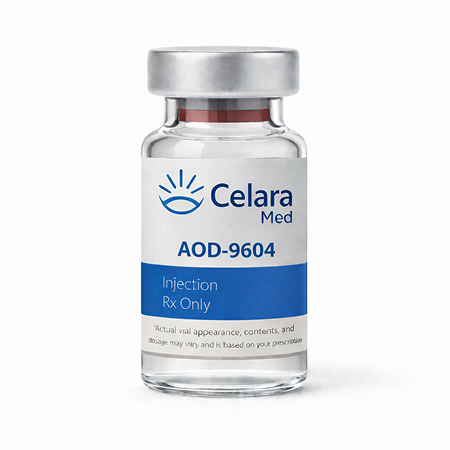
AOD-9604 / MOTS-c Stack
The AOD-9604 / MOTS-c stack combines two peptides studied for their roles in metabolic regulation, energy signaling, and cellular homeostasis…

B12 (Methylcobalamin)
Methylcobalamin is a bioactive form of vitamin B12 that plays a critical role in cellular energy metabolism, neurologic function, and…
AOD-9604
AOD-9604 is a synthetic peptide derived from a specific fragment of human growth hormone (HGH 176–191).
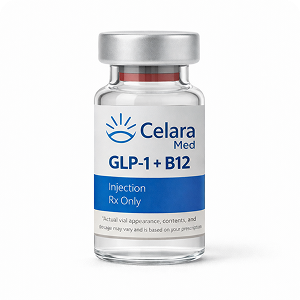
GLP-1
GLP-1–based therapy designed to support appetite regulation and metabolic balance under licensed provider supervision.